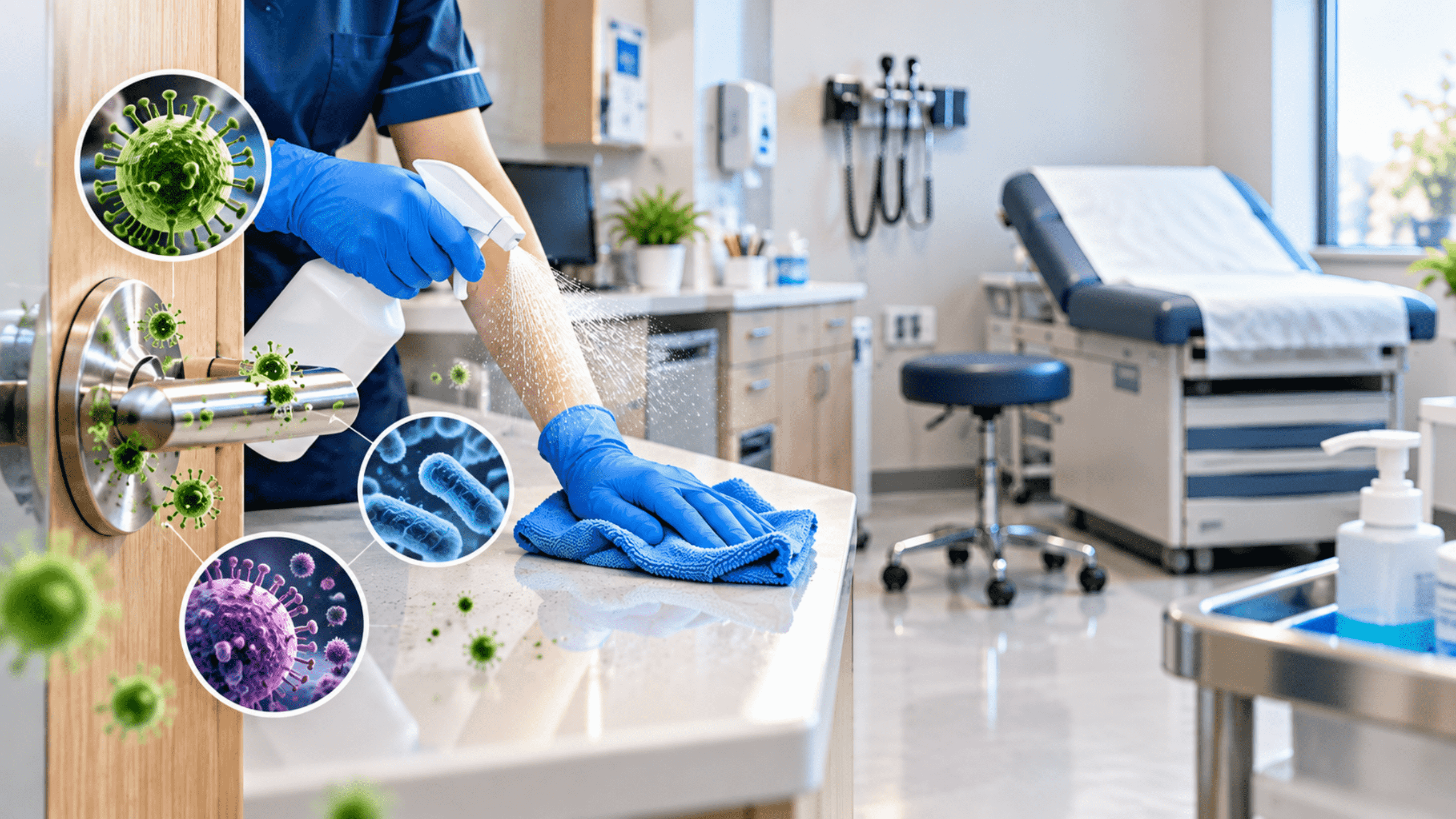
Medical offices require a higher level of cleaning and disinfection than many commercial spaces. Because patients, visitors, and staff frequently share rooms and touch common surfaces, proper medical office sanitation is essential to maintaining a clean environment.
Common cleaning mistakes, such as overlooking high-touch areas, using products incorrectly, or following inconsistent cleaning routines, can weaken infection control in medical offices. Proper cleaning procedures can help support infection prevention in healthcare facilities.
Professional medical office cleaning services in Knoxville can provide trained cleaning teams and consistent procedures to maintain healthcare environments. At Cherokee Cleaning Company, we provide affordable cleaning solutions tailored to the needs of medical and commercial facilities.
Why Proper Medical Office Cleaning Matters
Medical offices experience continuous movement throughout the day. Patients enter reception areas, sit in waiting rooms, use restrooms, visit examination rooms, and interact with staff and shared equipment. Because many people may touch the same surfaces, routine cleaning must be consistent and methodical.
Waiting room chairs, reception counters, door handles, examination tables, faucets, light switches, and frequently handled equipment can require regular attention. Simply making an office appear clean does not necessarily provide effective medical office disinfection. Cleaning removes dirt and organic material, while disinfection uses appropriate products and procedures to reduce harmful microorganisms on surfaces.
Strong cleaning procedures form an important part of broader infection control in medical offices. By combining appropriate cleaning methods with consistent schedules, staff training, and documented procedures, we can support infection prevention in healthcare environments while maintaining a professional setting for patients and employees.
Cleaning vs. Sanitizing vs. Disinfecting
Cleaning involves physically removing dirt, dust, debris, and organic material from surfaces. It is an essential first step because soil and debris can interfere with the effectiveness of some disinfecting processes.
Sanitizing reduces microorganisms on surfaces to levels considered safer according to applicable standards or product directions. It is not necessarily intended to eliminate all microorganisms.
Disinfecting involves using an appropriate chemical product and application procedure to destroy or inactivate many harmful microorganisms on surfaces. Proper product selection, application, and required contact time are important for effective disinfection.
7 Common Medical Office Cleaning Mistakes
Avoiding common medical office cleaning mistakes requires consistent procedures, suitable products, proper cleaning techniques, trained personnel, and attention to both visible and overlooked surfaces.
1. Cleaning High-Touch Surfaces Too Infrequently
One of the most common medical office cleaning mistakes is failing to clean frequently touched surfaces often enough. These surfaces may be handled repeatedly by patients, visitors, healthcare workers, and administrative staff throughout the day.
Common examples include:
- Door handles and knobs
- Light switches
- Reception counters
- Waiting room chairs and armrests
- Examination tables
- Faucet handles
- Shared keyboards and devices
- Medical equipment controls
- Cabinet and drawer handles
- Phones and other shared office equipment
A surface does not have to look dirty to require attention. High-touch areas can accumulate contamination through repeated contact even when they appear visually clean.
Effective medical office sanitation should identify high-touch surfaces and establish appropriate cleaning frequencies based on patient volume, room usage, and facility requirements. We can use room-specific checklists to ensure these areas receive consistent attention rather than relying only on visual inspections.
2. Using the Wrong Cleaning or Disinfecting Products
Not every cleaning product is appropriate for use in a healthcare environment. Selecting a product simply because it claims to clean a surface may not provide the level of disinfection required for a particular setting.
We should select cleaning and disinfecting products according to manufacturer instructions, facility requirements, surface compatibility, and the intended application. Product labels provide important information about dilution, application methods, required contact time, storage, and safety precautions.
Incorrect dilution can affect product performance, while wiping a disinfectant away before the required contact time may prevent it from working as intended. Using products on incompatible surfaces can also cause damage.
Proper medical office disinfection requires more than having disinfectants available. Cleaning personnel need to understand how and where products should be used, how long surfaces must remain appropriately wet when required, and what precautions should be followed during application. These practices support stronger infection control in medical offices.
3. Cleaning in the Wrong Order
Cleaning technique matters just as much as cleaning frequency. An ineffective sequence can move contaminants from one area to another rather than systematically removing them.
We generally work from cleaner areas toward areas that are more contaminated and from higher surfaces toward lower surfaces. This approach helps prevent debris and contaminants from falling onto areas that have already been cleaned.
Cleaning personnel should also use appropriate tools for different areas and avoid transferring the same materials between patient spaces without proper management. Equipment and supplies used in one room should not automatically be reused in another room if doing so could contribute to cross-contamination.
Why Cleaning Order Matters for Infection Prevention
A systematic cleaning sequence supports infection prevention in healthcare by reducing unnecessary movement of contaminants. When cleaning procedures are standardized, staff can follow the same process consistently rather than relying on individual habits.
This becomes especially important when multiple examination rooms, treatment spaces, restrooms, and shared areas must be cleaned during the same service period.
4. Reusing Cleaning Cloths and Equipment Without Proper Management
Using the same cleaning cloth, mop head, or other material across multiple areas without appropriate management can create cross-contamination concerns. A material that has already been used on one surface may transfer contaminants to another surface if it is reused incorrectly.
We should establish procedures for changing, laundering, disposing of, and storing cleaning materials. Depending on the facility and task, dedicated materials may be appropriate for particular rooms or surfaces.
Mop heads and reusable cloths should be handled according to established procedures rather than being repeatedly reused throughout the facility. Cleaning equipment should also be stored in a way that prevents clean materials from becoming contaminated.
A professional medical facility cleaning service can help establish structured equipment-management procedures so cleaning personnel understand when supplies need to be replaced, cleaned, laundered, or discarded.
5. Ignoring Less Obvious High-Touch Areas
Visible dirt often attracts attention, but many important touchpoints may look completely clean. Phones, keyboards, drawer handles, push plates, armrests, and medical equipment controls can be overlooked during routine cleaning.
Examples of less obvious touchpoints include:
- Computer keyboards
- Phones
- Door push plates
- Drawer handles
- Cabinet handles
- Chair armrests
- Equipment controls
- Waiting room tables
- Shared pens and touchscreens
- Faucet handles
A detailed cleaning checklist helps prevent these areas from being forgotten. We can identify surfaces according to how frequently they are touched and how they are used within each room.
Instead of focusing only on visible appearance, an effective cleaning program considers how people interact with the environment. This approach creates a more comprehensive sanitation routine.
6. Failing to Follow a Consistent Cleaning Schedule
Inconsistent cleaning can leave frequently touched surfaces untreated for longer than intended. A medical office may have different requirements for reception areas, restrooms, examination rooms, treatment spaces, staff areas, and other locations.
Cleaning frequencies should reflect room usage, patient volume, surface type, and facility procedures. High-traffic areas may require more frequent attention than spaces that are rarely occupied.
A documented schedule should clearly establish what needs to be cleaned, how often it should be cleaned, which procedures should be followed, and who is responsible for each task.
For facilities searching for medical office cleaning services near me, working with a professional provider can be a practical option when maintaining an internal cleaning schedule becomes difficult. Local cleaning providers can help facilities establish recurring service routines that align with their operational needs.
7. Overlooking Staff Training and Infection-Control Procedures
Even a detailed cleaning plan can be ineffective if cleaning personnel do not understand the procedures they are expected to follow. Training should address cleaning techniques, product handling, PPE requirements, cross-contamination prevention, equipment management, and product labels.
Personnel should understand the difference between cleaning and disinfection and recognize the importance of following manufacturer instructions. Where a product requires a specific contact time, staff should know how that requirement affects the cleaning process.
Regular quality checks can also help identify missed areas or inconsistent practices. Refresher training can be useful when procedures, products, equipment, or facility requirements change.
Strong training is therefore an important part of infection control in medical offices. Consistent procedures become easier to maintain when every member of the cleaning team understands the same standards.
Interesting Read: How Do Medical Office Cleaning Services Help Reduce Infection Spread in Hospitals?
How to Improve Medical Office Sanitation and Disinfection
Improving medical office sanitation begins with creating clear, repeatable procedures. We can establish room-specific protocols that identify surfaces, cleaning methods, products, and required frequencies.
A practical approach includes:
- Create room-specific cleaning protocols for waiting rooms, examination rooms, restrooms, treatment areas, and other spaces.
- Identify high-touch surfaces and establish appropriate cleaning intervals.
- Follow manufacturer instructions for every cleaning and disinfecting product.
- Use dedicated cleaning materials where appropriate to help reduce cross-contamination.
- Establish documented cleaning frequencies based on room usage and patient traffic.
- Train cleaning personnel in chemical handling, PPE, cleaning techniques, and infection-control practices.
- Maintain cleaning logs to document completed tasks and identify missed services.
- Perform regular quality inspections to verify that established procedures are being followed.
- Review procedures periodically when patient volume, facility layout, equipment, or operational needs change.
Build a Consistent Infection Prevention Routine
A consistent routine helps make cleaning less dependent on individual memory or judgment. We can use checklists, schedules, training, inspections, and documentation to create repeatable procedures.
When these elements work together, cleaning personnel have clear expectations for maintaining patient-facing areas and frequently touched surfaces. Consistency can support a cleaner environment for patients, visitors, healthcare professionals, and administrative staff.
Interesting Read: Top 5 Simple Tips for Keeping Your Medical Office Clean and Healthy
When Should a Medical Office Consider Professional Cleaning Services?
A medical office may benefit from professional cleaning support when patient volume is high, multiple examination or treatment rooms require attention, or in-house personnel cannot maintain a consistent schedule.
Professional support can also be useful when a facility needs detailed cleaning records, specialized healthcare cleaning procedures, or additional quality-control processes.
A reliable medical office cleaning company can help establish recurring cleaning routines while allowing healthcare personnel to focus on their primary responsibilities. Facilities may also compare different medical office cleaning companies to find a provider with appropriate healthcare experience, trained personnel, and flexible scheduling.
For larger or more specialized facilities, commercial medical cleaning services can provide structured support for multiple areas and recurring cleaning requirements. Property management cleaning services can also help property managers maintain clean, safe, and well-maintained medical facilities by coordinating routine cleaning schedules, common-area maintenance, and facility-specific cleaning needs.
Choosing the Right Medical Office Cleaning Company in Knoxville
Selecting the right provider requires more than comparing prices. A medical office cleaning company should understand the specific demands of healthcare environments and provide consistent procedures that support sanitation and disinfection.
When evaluating a provider, we recommend considering:
- Experience with healthcare environments
- Training provided to cleaning professionals
- Detailed cleaning and disinfection procedures
- Consistent service schedules
- Appropriate cleaning products and equipment
- Quality-control and inspection processes
- Flexible service options
- Clear communication and documentation
- Understanding of healthcare-specific cleaning requirements
A medical office cleaning company in Knoxville should be able to explain how its cleaning procedures address frequently touched surfaces, patient areas, restrooms, examination rooms, and other facility spaces.
Facilities searching for medical office cleaning services in Knoxville should also ask how schedules are developed and how completed work is monitored. A provider offering medical office cleaning should be prepared to adapt its service approach to the facility’s size, patient volume, room usage, and operational requirements.
How Cherokee Cleaning Company Supports Cleaner Medical Offices
Cherokee Cleaning Company provides professional cleaning services in Knoxville, TN, with support to help medical and commercial facilities maintain consistent cleaning routines. We focus on dependable service, careful attention to frequently touched areas, and structured cleaning procedures.
Medical offices can benefit from customized schedules that account for patient traffic, room usage, and facility requirements. We can also pay attention to commonly overlooked areas that may be missed during basic cleaning routines.
Our approach emphasizes consistency in sanitation and disinfection while helping facilities maintain a professional and orderly environment. By using established procedures and reliable scheduling, we help medical facilities maintain cleaning routines that support their broader infection-control practices.
For facilities seeking a dependable medical office cleaning service, professional cleaning support can make it easier to maintain consistent standards across patient-facing and staff areas.
Medical Office Cleaning Mistakes: Quick Checklist
A practical medical office cleaning checklist helps identify common mistakes and establish better practices for high-touch surfaces, disinfectant use, cleaning sequences, supplies, schedules, and staff training.
| Cleaning Mistake | Better Practice |
| Infrequent high-touch cleaning | Establish regular cleaning intervals |
| Wrong disinfectant | Follow product and facility requirements |
| Poor cleaning sequence | Clean systematically |
| Reusing contaminated materials | Use properly managed cleaning supplies |
| Ignoring hidden touchpoints | Include them in cleaning checklists |
| Inconsistent schedules | Maintain documented routines |
| Limited staff training | Provide ongoing training and quality checks |
Also Read: Building Cleaning Services Checklist
Keep Your Medical Office Cleaner and Better Prepared
Avoiding common cleaning mistakes is an important part of maintaining a clean and professionally managed medical environment. Consistent medical office sanitation, appropriate disinfection procedures, careful cleaning techniques, staff training, and documented schedules can help support broader infection-control practices. When internal resources are limited, professional cleaning support can provide the consistency needed across waiting rooms, examination areas, restrooms, treatment spaces, and high-touch surfaces.
Cherokee Cleaning Company is ready to support medical offices with dependable professional cleaning services in Knoxville. Contact Cherokee Cleaning Company at (865) 257-9854 to discuss your medical office cleaning needs.
FAQs About Medical Office Cleaning
How often should a medical office be cleaned?
Cleaning frequency depends on patient traffic, room usage, surface type, facility procedures, and the specific needs of the medical office. High-touch and frequently used areas generally require more consistent attention than low-traffic spaces.
What is the difference between medical office cleaning and regular commercial cleaning?
Medical office cleaning requires attention to healthcare-specific sanitation, disinfection, cross-contamination prevention, cleaning sequences, and product procedures. General commercial cleaning may not address the same healthcare-related requirements.
Why is disinfection important in a medical office?
Disinfection helps reduce harmful microorganisms on appropriate surfaces when the correct products and procedures are used. It is an important component of broader cleaning and infection-control practices within healthcare environments.
What surfaces should be cleaned most frequently in a medical office?
High-touch surfaces can include door handles, light switches, reception counters, chair armrests, examination tables, faucet handles, shared equipment, keyboards, phones, and frequently handled medical equipment controls.
Can improper cleaning increase infection risks?
Improper cleaning practices can contribute to cross-contamination or leave frequently touched surfaces inadequately treated. Using the wrong products, incorrect procedures, poor cleaning sequences, or inconsistent schedules can reduce cleaning effectiveness.
What should I look for in a medical office cleaning company?
Look for healthcare cleaning experience, trained personnel, documented procedures, appropriate products and equipment, consistent scheduling, quality inspections, clear communication, and an understanding of healthcare-specific cleaning requirements.
Do medical offices need specialized cleaning services?
The appropriate level of cleaning depends on the facility and its operations. Medical offices can benefit from providers familiar with healthcare environments, particularly when they need consistent disinfection procedures, detailed schedules, trained personnel, and quality-control processes.
How can professional cleaning services support infection prevention in healthcare?
Professional cleaning services can support established infection-control routines through consistent cleaning schedules, trained personnel, appropriate products, detailed checklists, high-touch surface cleaning, equipment management, and quality inspections.

Leave A Comment